Bookmaker Margin Calculator
Calculate the bookmaker's margin (overround/vig) to understand how much they take from every market.
Enter Market Odds
Understanding Bookmaker Margin
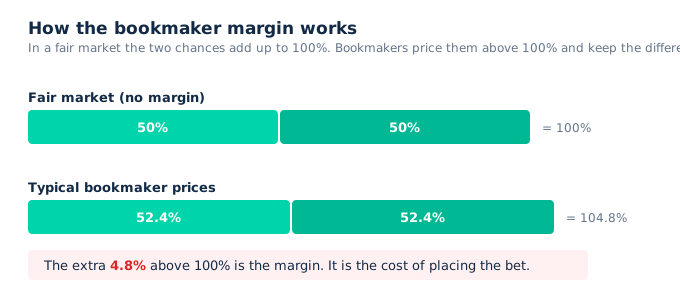
The margin (also called overround, vig, or juice) is how bookmakers guarantee profit. In a fair market, implied probabilities sum to 100%. Bookmakers inflate this to 102-110%, keeping the difference.
Example
A coin flip should be 2.00 for both sides (50% + 50% = 100%). Bookmakers might offer 1.91 each, giving: 52.4% + 52.4% = 104.8%. The 4.8% is their margin.
Why It Matters
Lower margin = better odds = better value for you. A 2% margin bookmaker gives you significantly better long-term returns than a 6% margin bookmaker.
Typical Margins
Pinnacle: 2-3% (best odds)
Bet365, Unibet: 4-6%
High street bookies: 6-10%
Novelty markets: 10-20%+
Where Margin Hurts You Most
Margin isn't uniform across a bookmaker's site. Main markets on major leagues are the most competitive and carry the tightest prices, because that's where informed money goes. Niche competitions, player props and novelty markets carry far wider margins, sometimes several times higher, because fewer sharp bettors are watching them.
Margin Compounds in Multiples
This is the part that surprises people. Each leg of an accumulator carries its own margin, and combining legs multiplies the effect. Four selections at roughly 5% margin each leave you facing something closer to 20% overall. That's why accumulators feel exciting and perform badly, and it's the single strongest argument for betting singles if you care about long-term results.
What It's Worth Over a Season
The difference between a 2% and a 6% margin sounds small on one bet. Across hundreds of bets it outweighs any welcome offer a bookmaker is likely to give you. Comparing the same market at several books, then converting to margin, is the fastest way to see who is actually giving you a fair price.