Poker Hand Rankings
The complete poker hand rankings from Royal Flush to High Card. Understand hand strength, ties, and why position matters more than memorizing rankings.
Last updated: 2026
In poker, the best five-card hand wins. Whether you're playing Texas Hold'em, Omaha, or Five Card Draw, these rankings apply. Memorize them before playing for real money.
Hand Rankings (Best to Worst)
Royal Flush
A♠ K♠ Q♠ J♠ T♠
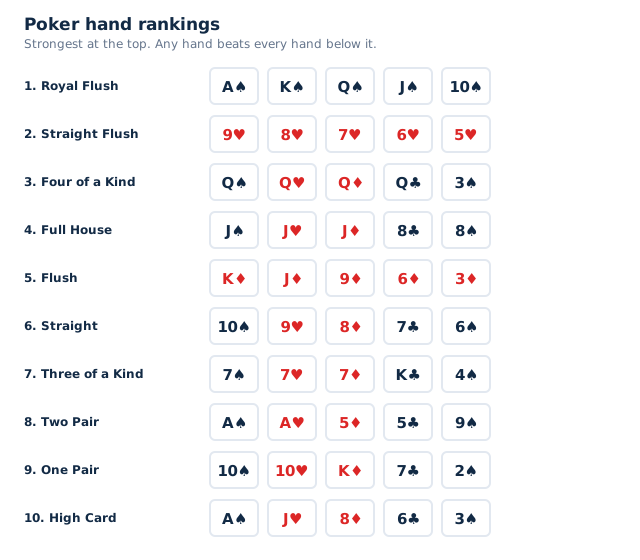
Ace, King, Queen, Jack, and Ten of the same suit. The best possible hand. You'll see this roughly once every 650,000 hands.
Straight Flush
8♥ 7♥ 6♥ 5♥ 4♥
Five consecutive cards of the same suit. A Royal Flush is just the highest straight flush. Between two straight flushes, the higher top card wins.
Four of a Kind (Quads)
9♠ 9♥ 9♦ 9♣ K♠
Four cards of the same rank. Higher quads beat lower quads. The fifth card (kicker) matters only if both players have the same quads.
Full House (Boat)
J♠ J♥ J♦ 4♠ 4♣
Three of a kind plus a pair. Called "Jacks full of fours" in the example. The three-of-a-kind rank determines the winner between full houses.
Flush
K♦ J♦ 8♦ 6♦ 3♦
Five cards of the same suit, not in sequence. When comparing flushes, the highest card wins. If equal, compare the second highest, and so on.
Straight
Q♠ J♥ T♦ 9♣ 8♠
Five consecutive cards of mixed suits. Ace can be high (A-K-Q-J-T) or low (5-4-3-2-A), but not both (K-A-2-3-4 is not valid).
Three of a Kind (Trips/Set)
7♠ 7♥ 7♦ K♣ 2♠
Three cards of the same rank. Higher three-of-a-kind wins. If equal (possible with community cards), kickers determine the winner.
Two Pair
A♠ A♣ 5♥ 5♦ Q♠
Two different pairs. The higher pair determines the winner. If those tie, the lower pair. If both pairs match, the kicker decides.
One Pair
T♠ T♦ A♣ 8♥ 3♠
Two cards of the same rank. Higher pair wins. If pairs are equal, compare kickers in order. Common hand. You'll make a pair about half the time in Hold'em.
High Card
A♠ J♣ 8♦ 6♥ 2♠
When you make nothing else, your highest card plays. Compare high cards; if equal, compare the next highest, and so on. "Ace-high" is the best high-card hand.
Important Rules
Kickers
When hands are of the same rank, kickers (unpaired cards) break ties. If you have A-A-K-8-4 and your opponent has A-A-Q-J-T, you win, your King kicker beats their Queen.
Suits Don't Matter
For ranking purposes, all suits are equal. A flush in hearts is not better than a flush in spades. The only time suit matters is when making a flush.
Five Cards Only
In Texas Hold'em, you make the best five-card hand from seven available cards (two hole cards plus five community cards). The unused cards don't count, even if they're high.
Approximate Probabilities in Texas Hold'em
Odds of making by the river (two hole cards + all five community cards):
| Hand | Probability (5 cards) |
|---|---|
| Royal Flush | 0.0032% |
| Straight Flush | 0.028% |
| Four of a Kind | 0.17% |
| Full House | 2.6% |
| Flush | 3.0% |
| Straight | 4.6% |
| Three of a Kind | 4.8% |
| Two Pair | 23.5% |
| One Pair | 43.8% |
| High Card | 17.4% |
Common Mistakes
Overvaluing Flushes and Straights
A flush beats a straight, but both lose to full houses and better. When the board pairs, your flush might be second best. Stay aware of what hands are possible.
Forgetting About Kickers
If you have A-3 and the board is A-K-Q-7-5, your hand is a pair of Aces with K-Q-7 kickers (your 3 doesn't play). Someone with A-4 would tie with you, both play A-A-K-Q-7.
Misreading the Board
Take your time. Count cards carefully. Miscounting straights or missing that the board has three to a flush are costly errors. There's no rush to declare your hand.
Playing the Board
If the board is A-K-Q-J-T of mixed suits, everyone has an Ace-high straight. Unless you hold a card that makes a flush, you're "playing the board" and will split the pot.
Hand Rankings Strategy and Context
Knowing hand rankings is just the beginning. What matters more is understanding hand strength in context: a pair of aces is unbeatable before the flop but can easily be beaten on a coordinated board.
Relative Hand Strength
In Texas Hold em, your hand strength is relative to the board and your opponents possible holdings. Top pair is strong on a dry board like K-7-2 rainbow but weak on a wet board like J-T-9 with two hearts. Always consider what hands beat you and whether your opponent could have them.
Position amplifies hand strength. The same hand plays more profitably in late position because you have more information about opponents actions before making decisions.
Drawing Hands vs Made Hands
Made hands like pairs and two pair have immediate value but limited improvement potential. Drawing hands like flush and straight draws have little current value but can become very strong. The art of poker is knowing when each type is favorable.
Pot odds determine whether drawing is profitable. If you need a 4:1 chance to complete your draw, the pot must offer at least 4:1 on your call. Our pot odds calculator helps with these decisions.
Kickers and Tie-Breakers
When players have the same hand rank, kickers determine the winner. With one pair, the highest kicker wins. This is why A-K beats A-Q when both hit an ace. Always consider your kicker when evaluating starting hands, K-9 looks similar to K-J but plays much worse.
Board Reading Skills
The community cards create possibilities for all players. On a board of J-T-9-4-2, any player with Q-8 or K-Q has a straight. Any player with two hearts has a flush if three hearts are showing. Reading the board means identifying all possible strong hands, not just your own.
Paired boards create full house possibilities. When the board shows K-K-7-7-2, any player with a king or seven has a full house. A player with pocket aces has only two pair despite having a premium starting hand.
Avoiding Common Mistakes
New players often overvalue hands. A flush is strong but loses to full houses, quads, and straight flushes. If the board pairs and an opponent bets heavily, your flush may be beaten.
Straights are vulnerable when flush draws are possible. The board 9-8-7-4-2 with three clubs means any player with two clubs beats your straight. Consider all possibilities before committing chips.
Hand Rankings in Different Poker Variants
Texas Hold'em and Omaha
Standard hand rankings apply to both games. The difference is in hand construction, Hold'em uses any combination of hole and community cards while Omaha requires exactly two hole cards and three board cards. This makes certain hands more common in Omaha.
Short Deck (6+ Hold'em)
With cards 2-5 removed, hand frequencies change. Flushes become harder to make than full houses, so flush beats full house in most short deck games. Check house rules before playing.
Lowball Games
In games like Razz or 2-7 Triple Draw, the goal is the lowest hand. Rankings are inverted: A-2-3-4-5 or 2-3-4-5-7 become premium hands depending on the variant.
Preflop Hand Selection
Starting hand strength correlates with final hand potential. Premium pairs (AA, KK, QQ) often make strong one-pair or set hands. Suited connectors (JTs, 98s) have straight and flush potential. Understanding this connection helps with preflop decisions.
Position affects playable hands. In early position, play tight with premium hands. In late position, widen your range because you'll have positional advantage postflop.
Postflop Hand Development
Hands change category as community cards appear. Your pocket kings start as a premium pair but become just one pair on a board of A-Q-J-7-2. Conversely, suited connectors may hit nothing on the flop but complete a flush by the river.
Evaluate your hand at each street. What started strong may weaken; what started speculative may improve. Flexibility in hand assessment separates winning players from losing ones.
Bluffing and Hand Representation
Understanding hand rankings enables effective bluffing. When the board shows K-Q-J-T-4 with no flush possible, betting represents a straight. Opponents must respect this possibility regardless of your actual holding.
Conversely, recognize when opponents might be representing strong hands. The same board that enables your bluff enables theirs. Hand reading combines board analysis with opponent tendencies.
Multi-Way Pot Considerations
Hand strength requirements increase in multi-way pots. One pair rarely wins against four opponents. Drawing hands gain value because implied odds improve, when you hit, more opponents may pay you off.
In heads-up pots, top pair is often good enough. In five-way pots, you typically need two pair or better. Adjust your standards based on the number of players contesting the pot.
Tournament vs Cash Game Considerations
Hand rankings don't change between formats, but their strategic implications do. In tournaments, stack preservation matters, marginal hands that risk your tournament life should be avoided. In cash games, you can rebuy, so maximizing expected value on each hand takes priority.
Practice and Memorization
Hand rankings should be automatic. Use online quizzes and flashcards until recognition is instant. During play, you can't afford time to remember whether a flush beats a straight.
Watch poker content and pause to evaluate hands. Practice reading boards quickly. The faster you process hand information, the more mental energy remains for strategic decisions.
Summary
Poker hand rankings form the foundation of all poker strategy. Memorize them completely, understand kickers and tie-breakers, and recognize how hand strength changes with board texture and opponent count. This knowledge enables everything else in poker.