Pot Odds & Implied Odds
The mathematical foundation of poker decision-making. When to call, when to fold, and why.
What Are Pot Odds?
Pot odds are the ratio between the current pot size and the cost of a call. They help you determine if calling is mathematically profitable based on your chances of winning.
Calculating Pot Odds
Pot odds = Pot size : Call amount
Example: Pot is $100, opponent bets $50. Pot is now $150. Call costs $50.
Pot odds = 150:50 = 3:1
As a percentage: $50 / ($150 + $50) = 25%
You need to win more than 25% of the time to profit.
Comparing to Equity
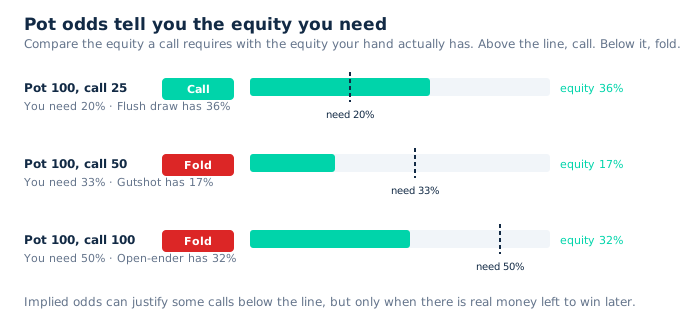
If your pot odds require 25% equity to call, and you estimate your hand has 30% chance to win, calling is profitable (+EV). If you only have 20% equity, folding is correct.
Quick Equity Estimates
Flush draw (9 outs): ~35% to hit by river, ~19% on one card
Open-ended straight (8 outs): ~31% by river, ~17% on one card
Gutshot (4 outs): ~17% by river, ~8.5% on one card
Two overcards: ~24% vs made pair
The Rule of 2 and 4
Quick estimate: Multiply outs by 4 for turn+river probability, multiply by 2 for single card.
9 outs × 4 = ~36% (actual: 35%)
Implied Odds
Implied odds account for money you expect to win on future streets if you hit. Important when drawing to hidden hands.
If pot odds say fold but you expect to win big when you hit, implied odds might make the call profitable.
Example: Set mining (calling with small pair hoping to flop a set). Pot odds are bad, but implied odds of stacking someone when you hit make it profitable in the right situations.
When Implied Odds Matter Most
• Deep stacks (more money to win)
• Hidden draws (opponent won't see it coming)
• Opponent can't fold (calling stations)
• Your draw is to the nuts
Reverse Implied Odds
Reverse implied odds represent money you might lose after hitting your draw. This occurs when your made hand loses to a better hand. You hit, bet big, and get beaten.
Example: You have J♦T♦ on a K♥9♦8♦ board. You're drawing to a flush, but if the A♦ comes, someone with A♦x♦ has a better flush. Your reverse implied odds are poor because hitting may cost you stacks.
Non-nut draws have significant reverse implied odds. The more ways your completed hand can be beaten, the worse your reverse implied odds become.
Calculating Pot Odds Step by Step
Step 1: Determine the Pot Size
Add all money currently in the pot, including your opponent's bet. If the pot was $50 and your opponent bets $25, the pot is now $75.
Step 2: Note the Call Amount
How much must you put in to continue? In our example, you must call $25.
Step 3: Calculate Your Odds
Divide total pot by your call: $75 ÷ $25 = 3. Your pot odds are 3:1. As a percentage: $25 ÷ ($75 + $25) = 25%.
Step 4: Count Your Outs
How many unseen cards complete your hand? Flush draw = 9 outs. Open-ended straight = 8 outs. Gutshot = 4 outs.
Step 5: Calculate Drawing Probability
Use the rule of 2 and 4. Multiply outs by 2 for one card, by 4 for two cards (turn and river combined).
Step 6: Compare and Decide
If your drawing probability exceeds the pot odds requirement, call. If pot odds require 25% equity and you have 35%, you have a profitable call.
Outs and Probability Reference
These probabilities assume no opponent cards are known:
2 outs: 4% one card, 8% two cards (pocket pair to set)
4 outs: 9% one card, 17% two cards (gutshot straight)
6 outs: 13% one card, 24% two cards (two overcards)
8 outs: 17% one card, 32% two cards (open-ended straight)
9 outs: 19% one card, 35% two cards (flush draw)
12 outs: 26% one card, 45% two cards (flush + gutshot)
15 outs: 33% one card, 54% two cards (flush + open-ender)
Blockers and Card Removal
When counting outs, consider which cards might be in opponent hands. If you're drawing to a flush and the board shows two hearts, but your opponent likely has hearts based on their betting, your actual outs may be fewer than nine.
Similarly, if you hold blockers to opponent hands, your equity increases. Holding A♠ when drawing means no opponent can have the nut flush.
Multi-Way Pot Considerations
Pot odds improve in multi-way pots because more money goes in before your call. Three opponents each putting in $20 creates $60 pot for your $20 call, better odds than heads-up.
However, reverse implied odds worsen in multi-way pots. More opponents means more chance someone has you drawing dead or to a second-best hand.
Pot Odds on the Flop vs. Turn
On the flop, you have two cards to come. Your immediate pot odds apply to calling for one card (the turn). If you call, you'll face another decision on the turn.
Comparing flop calls to two-card probabilities works only if you expect to see the river for free or face a small turn bet. Against aggressive opponents who will bet again, use single-card probabilities.
Expected Value Calculations
Pot odds simplify EV calculations. If calling costs $25 for 3:1 pot odds (25% required equity) and you have 35% equity, your EV is positive.
Exact calculation: (35% × $100 total pot) - (65% × $25 call) = $35 - $16.25 = +$18.75 expected value per call.
Over many similar situations, this positive EV accumulates into significant profit. Poker profitability comes from consistently making +EV decisions.
Implied Odds in Practice
Set mining illustrates implied odds perfectly. Calling $3 preflop with 3♣3♦ hoping to flop a set offers immediate pot odds of maybe 5:1 or worse. You'll flop a set only 12% of the time.
But when you hit, you might win your opponent's entire 100BB stack. This 30:1 implied payout makes the 8:1 odds against flopping a set profitable. Without implied odds, set mining fails.
Key requirement: Deep stacks. If effective stacks are only 20BB, you can't win enough post-flop to justify the preflop call.
Pot Odds and Bluffing
The same math applies to bluffing. If you bet $50 into $50, your opponent faces 2:1 pot odds and needs 33% equity to call profitably.
This means your bluff needs to work only 50% of the time to break even. If you bluff in spots where opponents fold more than half the time, you profit regardless of your cards.
Understanding your opponent's pot odds helps structure bets. Larger bets require higher fold equity to profit. Smaller bets offer better pot odds to opponents, requiring less fold equity but risking more calls.
Common Pot Odds Mistakes
Overestimating Outs
Not all outs are clean. If you're drawing to a straight but three cards of one suit are showing, your straight might lose to a flush. Discount outs that could complete opponent hands.
Ignoring Position
Pot odds don't account for informational disadvantage. Being out of position means you act first, potentially facing bets on future streets. Implied odds are harder to realize out of position.
Calling Without Counting
Many players call draws without calculating odds. This leads to too many unprofitable calls with weak draws. Always know your pot odds before deciding.
Using Pot Odds at the Table
Practice until basic calculations become automatic. You should instantly recognize 4:1 pot odds or 30% equity requirements. Speed matters in live play where visible hesitation reveals information.
Start with common situations. Flush draws on the flop (35% to hit by river), open-enders (32%), gutshots (17%). Know these numbers cold.
Advanced Pot Odds Applications
Semi-Bluffing with Draws
When you have a draw, betting combines immediate fold equity with draw equity. Even if called, you can still win by hitting your draw. This dual chance makes aggressive draw play often superior to passive calling.
Calculate semi-bluff profitability by combining fold equity with pot equity when called. Strong draws against opponents who fold frequently become highly profitable semi-bluffs.
Pot Odds and Stack Sizes
Stack-to-pot ratio affects implied odds significantly. Deep stacks mean more potential future winnings; short stacks limit implied odds. Adjust calling standards based on effective stack depth.
All-in situations eliminate implied odds entirely. You can only win what's already in the pot. Pure pot odds calculations become sufficient when no future betting is possible.
Multi-Way Pot Considerations
In multi-way pots, multiple opponents may call behind you, improving your pot odds. However, one of multiple opponents is more likely to have a strong hand, reducing your winning chances when you hit.
Draws to the nuts gain value in multi-way pots, when you hit, you're likely best. Non-nut draws lose value because better draws may be out.
Pot Odds Software and Tools
Equity calculators show precise winning percentages against opponent ranges. Use these tools during study sessions to verify hand calculations and build intuition.
During play, rely on memorized common situations. You won't have time to input hands into calculators in real-time. Practice makes mental calculations fast and accurate.
Common Pot Odds Situations
Flush Draw on Flop
Nine outs, approximately 35% to hit by river (19% per street). Need about 2:1 pot odds for a call that sees both remaining cards. Single-card equity is roughly 4:1.
Open-Ended Straight Draw
Eight outs, approximately 32% to hit by river (17% per street). Similar pot odds requirements to flush draws.
Gutshot Straight Draw
Four outs, approximately 17% to hit by river (8.5% per street). Need strong implied odds to justify calls, rarely profitable based on pot odds alone.
Set Over Set
One out, approximately 4% to improve. Only call when pot odds are exceptional or against extremely short stacks.
Practice Exercises
Calculate pot odds for common situations until answers come instantly. Deal practice hands and evaluate decisions against mathematical standards. Review played hands to identify pot odds errors.
Understanding pot odds transforms poker from guesswork into calculated decision-making. The investment in learning pays dividends throughout your poker career.
Final Thoughts
Pot odds are fundamental to winning poker. Without understanding them, you're making random decisions where mathematical precision is possible. Learn the concepts, practice the calculations, and apply them consistently.
Every profitable poker player understands pot odds intuitively. Join them by making this knowledge automatic through dedicated study and practice.