How Bookmakers Work
Bookmakers build profit margins into every market through the overround. Understanding how odds are set, why lines move, and how bookies manage risk helps you identify better betting opportunities.
The Bookmaker Business Model
Bookmakers profit by taking a margin on every market. They don't need to predict winners. They need to set prices that attract balanced action and guarantee profit regardless of outcome.
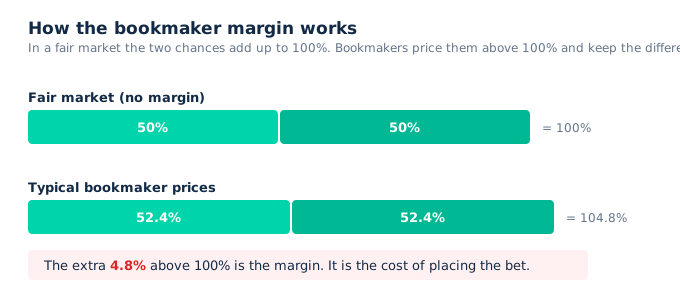
The Overround (Margin)
In a fair coin flip, true odds would be 2.00 on each side. A bookmaker might offer 1.91 on both:
- Implied probability: 1/1.91 = 52.4% each side
- Total: 104.8%
- Overround: 4.8%
This extra 4.8% is the bookmaker's edge, their guaranteed profit margin.
How Odds Are Set
1. Opening Lines
Traders set initial odds using statistical models, historical data, team news, and market expectations.
2. Market Movement
As money comes in, bookmakers adjust odds to balance their liability. Heavy betting on one side shortens those odds and lengthens the other.
3. Sharp Money
Bookmakers pay attention to "sharp" bettors (professionals). When sharps bet, odds move quickly. Their action reveals information.
4. Closing Line
The final odds before an event starts are typically the most accurate, as they incorporate all market information.
Risk Management
Balancing the Book
Ideally, bookmakers want equal liability on all outcomes. They profit from margin regardless of who wins.
Accepting Imbalanced Positions
Sometimes bookmakers hold positions if they believe the market is wrong. This is riskier but potentially more profitable.
Laying Off Risk
Bookmakers can bet at other bookmakers or exchanges to reduce exposure on large positions.
How Bookmakers Deal With Winners
Account Restrictions
Consistent winners face stake limits, reduced odds, or account closure. This is legal and standard practice.
Why They Limit Winners
Winning bettors provide information (their bets reveal mispriced odds) but cost money. Bookmakers want recreational bettors who lose over time.
Different Types of Bookmakers
Sharp Books (e.g., Pinnacle)
Welcome all bettors, offer low margins, and don't limit winners. They profit from volume and efficiency.
Soft Books (Most Retail Bookmakers)
Higher margins, more promotions, limit winning accounts. Target recreational bettors.
What This Means For You
- The margin means you start at a disadvantage
- Bookmakers are very good at setting accurate odds
- If you win consistently, expect restrictions
- Use odds comparison to find the best prices
- Understand that bonuses offset some of the margin
The Odds Compilation Process
Modern bookmakers use sophisticated statistical models combining historical data, current form metrics, injury reports, and hundreds of other variables. Quantitative analysts, often with backgrounds in mathematics, statistics, or finance, build and refine these models continuously.
For major markets like Premier League football, models incorporate expected goals data, player tracking statistics, squad rotation patterns, and even weather forecasts. The resulting probability estimates feed into pricing algorithms that set initial odds.
Despite this sophistication, opening lines contain errors. Markets become more accurate as betting volume reveals information. The closing line, odds at event start, typically represents the market's best probability estimate.
Understanding Different Margin Structures
Margins vary significantly between markets and bookmakers. Main match result markets on major football leagues might carry 3-5% margins at sharp bookmakers, while exotic props or minor leagues can exceed 15%.
Lower margins don't always mean better value. A bookmaker with 5% margin on efficient lines might offer worse prices than one with 8% margin on inefficient lines. Compare actual prices, not just theoretical margins.
In-play markets typically carry higher margins than pre-match due to increased uncertainty and the bookmaker's need to react quickly to changing situations.
How Bookmakers Identify Sharp Bettors
Bookmakers track every customer's betting patterns. Consistent winners, bets placed immediately after markets open, maximum stake bets, and following steam moves all trigger scrutiny.
Sophisticated tracking identifies subtle patterns: customers who only bet certain events, those whose bets correlate with line movements, or accounts that consistently beat the closing line. Detection algorithms improve constantly.
Account restrictions typically escalate: maximum stakes reduce first, then offered odds decrease, finally accounts may close entirely. Appeals rarely succeed, bookmakers have no obligation to accept winning customers.
The Role of Market Makers
Some bookmakers act primarily as market makers, offering prices on every event and accepting bets from all customers. Pinnacle exemplifies this approach. They welcome sharp action because it helps them price markets more accurately.
Market makers profit from volume and accuracy rather than from customer losses. Their lower margins attract both recreational and professional bettors, creating liquid markets that efficiently incorporate information.
Promotional Economics
Free bets, deposit bonuses, and enhanced odds represent calculated customer acquisition costs. Bookmakers know exactly how much promotional spending generates long-term profitable customers.
The mathematics typically work in the bookmaker's favor. A £30 free bet might cost them £25 in expected payouts, but if it creates a customer who loses £200 over the next year, it's profitable acquisition spending.
Promotions targeting existing customers (reload bonuses, loyalty rewards) aim to increase betting frequency and maintain engagement. These offers often have terms that reduce actual value below headline figures.
Arbitrage and the Bookmaker Response
Arbitrage, betting all outcomes across bookmakers to guarantee profit, exploits pricing differences. Bookmakers actively work to eliminate these opportunities through rapid odds synchronization.
Modern arbitrage detection systems identify customers who only bet when arbitrage exists. These accounts face swift restrictions regardless of individual profitability: the pattern itself triggers action.
Some bookmakers intentionally create arbitrage opportunities to attract sharp bettors whose action provides pricing information. They treat this as market research cost rather than lost revenue.
Regulatory Environment Impact
Licensing requirements affect bookmaker operations significantly. UK Gambling Commission rules mandate customer protection measures, responsible gambling tools, and advertising restrictions.
Regulatory compliance costs influence margins and market offerings. Heavily regulated markets often see higher minimum margins and fewer promotional offers as bookmakers cover compliance expenses.
Different jurisdictions create varied competitive markets. Some markets feature dozens of licensed operators; others have state monopolies or severe restrictions limiting consumer choice.
Technology and Real-Time Pricing
In-play betting requires instant odds updates based on event developments. Algorithms process live data feeds, goals, possession, shots, game state, to continuously reprice markets.
Latency matters enormously. Bookmakers race to update odds faster than bettors can exploit delayed information. This technological arms race consumes significant industry investment.
Machine learning increasingly drives both pricing and customer profiling. Neural networks identify patterns humans might miss, both in sports outcomes and in customer behavior prediction.
The Information Ecosystem
Bookmakers consume huge information streams: official data feeds, social media monitoring, injury reports, weather services, and proprietary intelligence networks. Information advantages translate directly into pricing accuracy.
Conversely, betting markets generate information. Odds movements reveal market expectations; sharp money indicates where informed bettors see value. Some trading firms use betting market data as signals for other financial activities.
Why Understanding This Helps You
Knowing how bookmakers operate provides strategic advantage. Understanding margins helps identify better value. Recognizing restriction triggers helps maintain account longevity.
Accept that bookmakers are sophisticated opponents with significant advantages. Approach betting with realistic expectations, most bettors lose because the system is designed to ensure they do.
If you choose to pursue profitable betting, focus on areas where your information or analysis genuinely exceeds what bookmakers possess. Generic approaches against professional operations rarely succeed.
The Bettor's Response
Understanding bookmaker operations informs betting strategy. Use multiple bookmakers to access best prices. Maintain accounts carefully to extend longevity. Recognize when offers represent genuine value versus customer acquisition traps.
Accept that betting against sophisticated opponents requires genuine edge, not just effort or passion. Most bettors lack this edge regardless of how hard they try. Honest self-assessment prevents prolonged losing.
Evolution of the Industry
The betting industry evolves rapidly. Mobile betting transformed customer behavior. Data proliferation increased pricing accuracy. Regulatory changes reshape market structures. Understanding these trends helps predict future opportunities and challenges.
Customer expectations rise continuously. Features that differentiated bookmakers years ago are now standard. Competitive pressure drives innovation but also increases pricing efficiency, making value harder to find.
Bookmaker Business Models
Different bookmakers pursue different strategies. Some maximize recreational bettor volume through promotions and entertainment features. Others court serious bettors with sharp pricing and high limits. Understanding which type you're dealing with informs your approach.
Publicly traded bookmakers publish financial reports revealing their economics. These documents show actual margins, customer acquisition costs, and profitability, useful context for understanding the industry.
The Future of Bookmaking
Technology continues transforming bookmaking. Machine learning improves pricing accuracy. Real-time data feeds enable faster live betting. Mobile-first design captures casual bettors. These trends will continue, generally making markets more efficient.
Regulatory environments evolve constantly. Some jurisdictions increase restrictions; others liberalize. These changes affect market structure, competition, and bettor options. Stay informed about regulatory developments affecting your situation.
Key Takeaways
Bookmakers profit through margins built into every market. They restrict winning customers and promote high-margin products like accumulators. Understanding their business model helps you navigate betting markets more effectively and maintain realistic expectations.
This knowledge serves both recreational and professional bettors. Recreational bettors understand the cost of their entertainment. Professional bettors understand the competitive world they must navigate for potential profit.