Betting Odds Explained
How to read odds in any format, calculate potential returns, and understand what the numbers really mean.
Last updated: 2026
Odds tell you two things: how much you can win relative to your stake, and the implied probability of that outcome occurring. Different regions use different formats, but they all convey the same information.
The Three Main Odds Formats
Decimal Odds
Most common in Europe, Australia, and increasingly worldwide. Decimal odds show your total return (stake plus profit) per unit staked.
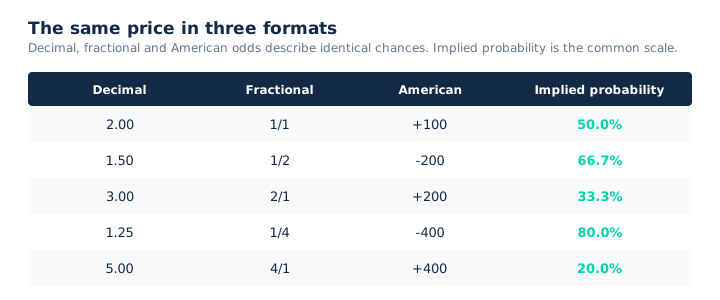
Example: Odds of 2.50 mean a £10 bet returns £25 total (£10 stake + £15 profit) if successful.
Calculation: Total Return = Stake × Decimal Odds
Decimal odds are intuitive for comparing value. Higher numbers mean higher potential returns but lower probability. Odds of 1.50 return less than odds of 3.00, but 1.50 implies a higher chance of winning.
Fractional Odds
Traditional in the UK and Ireland, particularly for horse racing. Fractional odds show potential profit relative to stake.
Example: Odds of 5/2 (said as "five to two") mean a £2 bet wins £5 profit, plus your £2 stake back. A £10 bet at 5/2 returns £35 (£25 profit + £10 stake).
Calculation: Profit = Stake × (Numerator / Denominator)
Common fractional odds include: Evens (1/1), 2/1, 5/2, 7/4, 11/8. "Odds-on" selections (favorites) are expressed as fractions below 1/1, like 4/6 or 1/3.
American (Moneyline) Odds
Standard in the United States. Positive numbers show profit on a $100 stake; negative numbers show how much you must stake to win $100.
Positive Example: +250 means a $100 bet profits $250 if successful (total return $350).
Negative Example: -150 means you must bet $150 to profit $100 (total return $250).
Negative odds indicate favorites; positive odds indicate underdogs. The further from zero, the more extreme the implied probability.
Quick Conversion Reference
| Decimal | Fractional | American | Implied Probability |
|---|---|---|---|
| 1.50 | 1/2 | -200 | 66.7% |
| 2.00 | 1/1 (Evens) | +100 | 50.0% |
| 2.50 | 6/4 | +150 | 40.0% |
| 3.00 | 2/1 | +200 | 33.3% |
| 4.00 | 3/1 | +300 | 25.0% |
| 10.00 | 9/1 | +900 | 10.0% |
Implied Probability
Every set of odds implies a probability. This is what the bookmaker's odds suggest about the likelihood of an outcome. Understanding implied probability helps you evaluate whether odds represent good value.
Decimal to Probability: Probability = 1 / Decimal Odds × 100
At odds of 2.00: 1/2.00 = 0.50 = 50%
At odds of 4.00: 1/4.00 = 0.25 = 25%
Fractional to Probability: Probability = Denominator / (Numerator + Denominator) × 100
At odds of 3/1: 1/(3+1) = 0.25 = 25%
At odds of 1/4: 4/(1+4) = 0.80 = 80%
The Bookmaker's Margin
Here's where it gets important. Bookmakers don't offer fair odds. They build in a margin that aims to provide their profit.
If a coin flip had fair odds, both heads and tails would be priced at 2.00 (50% implied probability each, totaling 100%). Instead, a bookmaker might offer 1.91 on each side.
Converting 1.91 to probability: 1/1.91 = 52.4%
Total implied probability: 52.4% + 52.4% = 104.8%
That extra 4.8% above 100% is the overround: the bookmaker's margin. It means that even if you bet equally on both sides, you'd lose money overall.
The margin is the single most important thing to understand about betting odds. It's not hidden, but it's rarely emphasized. Every bet you place is priced to favor the bookmaker. Over enough bets, this mathematical edge is why most bettors lose.
Calculating the Overround
To find the bookmaker's margin on any market, convert all odds to implied probabilities and add them up. The amount above 100% is the margin.
Example - Football Match:
- Home Win: 2.10 → 47.6%
- Draw: 3.40 → 29.4%
- Away Win: 3.50 → 28.6%
- Total: 105.6%
The 5.6% overround is the bookmaker's built-in advantage. Different bookmakers and different markets have different margins. Competitive markets like major football leagues might have 3-5% margins; niche markets or exotic bets often exceed 10%.
What "Value" Means
Bettors often talk about "value": the idea that the true probability of an outcome is higher than the implied probability of the odds. If you believe a team has a 50% chance of winning, but the odds imply only 40%, that's theoretically a value bet.
The problem: accurately assessing true probabilities is extremely difficult. Bookmakers employ teams of analysts and use sophisticated models. The odds generally reflect reality better than individual bettors can assess it.
This doesn't mean value never exists, bookmakers can be wrong, especially in less-followed markets. But consistent identification of value is what separates the tiny minority of profitable bettors from everyone else.
Odds Movement
Odds change between when they're first posted and when the event starts. This happens because:
Betting Volume: When lots of money comes in on one side, bookmakers adjust odds to balance their liability. Heavy backing of a favorite shortens their odds while lengthening the underdog's.
New Information: Team news, injuries, weather conditions, anything affecting the likely outcome can trigger odds movement.
Sharp Action: When known successful bettors place wagers, bookmakers often move odds quickly, respecting the information these bets might represent.
Odds movement itself tells you something: big shifts suggest significant money or information entering the market.
Practical Takeaways
Understanding odds isn't about finding a secret to winning. It's about knowing what you're dealing with:
- Learn to convert between formats and calculate implied probability
- Check the margin before betting, lower margins mean less disadvantage
- Don't confuse low odds with certainty; upsets happen regularly
- Higher odds mean higher potential returns but lower probability
- The odds are set by experts; beating them consistently is rare
Odds are the price of a bet. Like any price, they can be fair or unfair. Unlike most purchases, though, you never know whether you got good value until after the event, and even then, one outcome doesn't prove anything about the probability.
Advanced Odds Concepts
Understanding basic odds formats is just the start. Advanced bettors dig deeper into probability theory, market efficiency, and the mathematical structures that underpin all gambling.
True Odds vs Displayed Odds
True odds reflect actual probability without any margin. Displayed odds include the bookmaker margin. For a fair coin flip, true odds are 2.00 on each side (50% probability). A bookmaker might offer 1.91 on each side, creating a 4.7% margin. Understanding this gap is essential for finding value.
Calculate margin by summing implied probabilities for all outcomes in a market. Total minus 100% equals the margin. Lower-margin bookmakers offer better long-term value.
Market Efficiency and Soft Markets
Major markets like Premier League match odds are highly efficient, thousands of sharp bettors ensure prices quickly reflect true probabilities. Finding consistent value in efficient markets is extremely difficult.
Softer markets, lower-league football, niche sports, player props, in-play markets, may have more pricing errors. Bookmakers cannot employ experts in every obscure market, creating potential opportunities for specialists.
Odds Movement and Information
Odds move for two reasons: money and information. Heavy betting on one side forces bookmakers to adjust prices to balance their liability. New information, injuries, weather, lineup changes, triggers rapid movement as the market reprices.
Sharp money moves lines quickly. When odds shift significantly without obvious news, professional bettors may have found something. Some bettors attempt to follow these movements, though by the time you notice, the value may be gone.
Converting Probability to Required Win Rate
Your required win rate to break even depends entirely on your average odds. At decimal 2.00, you need 50% winners. At 3.00, you need 33.3%. At 1.50, you need 66.7%. This calculation reveals whether your historical win rate actually represents profit.
Many bettors win over 50% of bets but still lose money because they consistently bet on heavy favorites. A 55% win rate at average odds of 1.70 loses money because break-even requires 58.8% winners.
Compound Odds in Accumulators
Accumulator odds multiply together: 2.00 times 2.00 times 2.00 equals 8.00. But so do the margins. A 5% margin on each leg compounds to roughly 15% margin on a treble. This is why bookmakers promote accumulators heavily. They are extremely profitable for the house.
Accumulators also compound errors in probability assessment. If you slightly overestimate probability on each leg, the accumulated error becomes significant.
Closing Line Value
The closing line, odds at event start, represents the most accurate market price after all information is incorporated. Consistently beating the closing line is the strongest indicator of betting skill. If your bets close at worse odds than you took, you are finding value. If they close at better odds, you are getting bad prices.
Track your closing line value over hundreds of bets. This metric predicts long-term results better than short-term profit or loss.
Asian Handicap Odds
Asian handicap betting eliminates the draw by applying goal handicaps to teams. A -0.5 handicap means your team must win outright. A -1.5 handicap requires winning by two or more goals. Quarter handicaps like -0.75 split your stake between two lines, creating partial win or loss scenarios.
Asian handicaps typically carry lower margins than traditional 1X2 markets. The elimination of the draw option makes pricing more efficient and appeals to serious bettors seeking better value. Understanding how to read and calculate Asian handicap payouts is essential for football betting.
Over/Under and Totals Betting
Totals betting focuses on combined scores rather than match outcomes. Over/Under 2.5 goals is the most common football line, over wins if three or more goals are scored, under wins if two or fewer. Half-goals eliminate pushes, ensuring every bet wins or loses.
Totals markets respond to different factors than match result betting. Weather, playing styles, referee tendencies, and tournament stage all influence goal expectancy. Teams playing open, attacking football create value in overs; defensive matchups favor unders.
Understanding Line Movement Patterns
Opening lines appear when bookmakers first post odds, often days before an event. These early prices reflect bookmaker models and initial market expectations. As betting volume increases, lines adjust toward their true probability.
Steam moves occur when multiple bookmakers simultaneously shift odds in the same direction, typically indicating coordinated professional betting. Reverse line movement happens when odds move opposite to betting percentages, suggesting sharp money on the less popular side.
Learning to interpret line movement helps identify where professional bettors are placing their money. However, following steam moves blindly rarely works, by the time public bettors notice, the value has usually disappeared.
Exchange Odds vs Bookmaker Odds
Betting exchanges like Betfair allow bettors to bet against each other rather than against a bookmaker. Exchange odds typically offer better value because there's no built-in margin, instead, the exchange takes a small commission on winnings.
Exchange prices represent true market consensus. When exchange odds diverge significantly from bookmaker odds, arbitrage opportunities may exist. Exchanges also allow laying, betting against outcomes, which enables hedging and trading strategies unavailable at traditional bookmakers.
However, exchanges have liquidity limitations. Popular markets offer substantial liquidity, but niche markets may not have enough money available to place large bets at displayed odds.
Converting Between Odds Formats
Different regions prefer different odds formats. Europeans use decimals, British punters favor fractions, and Americans stick with moneylines. Converting between formats is essential for comparing prices across international bookmakers.
Decimal to fractional: subtract 1 and express as a fraction. Decimal 2.50 becomes 3/2. Decimal to American: for odds above 2.00, multiply the decimal minus 1 by 100 (2.50 becomes +150). For odds below 2.00, divide -100 by the decimal minus 1 (1.50 becomes -200).
Most betting tools and websites offer automatic conversion, but understanding the mathematics helps you quickly assess value when switching between different bookmaker interfaces.
Probability and the Law of Large Numbers
Individual bet outcomes are unpredictable, but patterns emerge over large samples. The law of large numbers guarantees that actual results approach expected probability given sufficient trials. This mathematical certainty underpins both bookmaker profitability and value betting strategy.
For bettors, this means short-term results are meaningless indicators of skill. A profitable bettor may endure months of losses; a losing bettor may enjoy lengthy winning streaks. Only results over thousands of bets reliably indicate edge, or lack thereof.
Understanding this concept prevents overreaction to variance. Winning doesn't make you a genius; losing doesn't make you an idiot. Focus on process quality rather than recent outcomes.