Over/Under Betting Guide
Betting on total goals or points regardless of who wins. Focus on game tempo, not the outcome.
What is Over/Under Betting?
Over/Under betting means predicting whether the total combined score will be above or below a line set by the bookmaker. You're not betting on who wins, just on the total scoring.
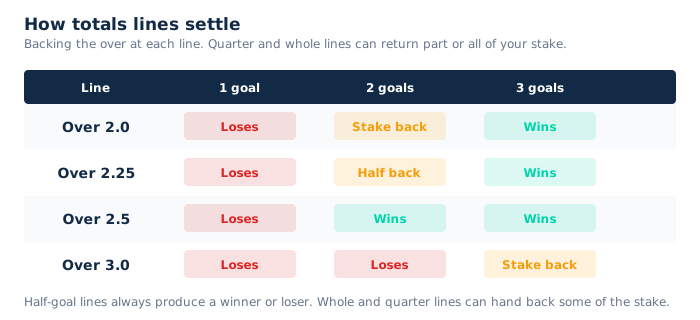
Example: Football Over/Under 2.5 Goals
Over 2.5: You win if the match has 3 or more goals total
Under 2.5: You win if the match has 0, 1, or 2 goals total
The .5 eliminates the possibility of a push. There's always a winner.
Common Lines by Sport
Football (Soccer): 2.5 goals is the standard. Also see 1.5, 3.5
Basketball (NBA): Typically 210-230 points total
American Football: Usually 40-55 points
Tennis: Total games in a match
Whole Number Lines
Lines like Over/Under 2 or Over/Under 3 create push scenarios:
Over 2: Exactly 2 goals = push (stake refunded). 3+ goals = win. 0-1 goals = lose.
Asian Totals
Quarter lines like 2.25 or 2.75 split your stake:
Over 2.25: Half stake on Over 2, half on Over 2.5
3 goals: Full win. 2 goals: Half win, half push. 0-1 goals: Full loss.
Strategy Considerations
• Research team scoring/conceding averages
• Consider weather, injuries, motivation
• Cup games often differ from league games
• Late-season dead rubbers can be high scoring
• In-play totals move based on game state
Why Totals Markets are Popular
You can have an opinion on game tempo without predicting the winner. High-scoring teams playing each other? Over. Two defensive teams in bad weather? Under. It's betting on patterns rather than picking sides.
Understanding Expected Goals (xG) for Totals
Expected goals measure the quality of scoring chances created. A team averaging 1.8 xG per game creates chances worth 1.8 goals on average, regardless of actual finishing. Comparing team xG gives better totals predictions than raw goal averages, which include finishing variance.
When two teams with high xG meet, over bets become attractive. Conversely, teams with low xG against suggest unders, even if recent scorelines included lucky goals. xG reveals sustainable attacking quality that influences future games.
Weather and Playing Conditions
Weather significantly affects totals, particularly in outdoor sports. Heavy rain, strong wind, and extreme cold typically reduce scoring. Snow-covered pitches slow play and disrupt passing. Heat can cause fatigue in later stages, sometimes increasing late goals as defenses tire.
Check weather forecasts before betting totals. A forecast changing from clear to heavy rain might create value on unders that the market hasn't fully priced. Similarly, covered stadiums neutralize weather factors entirely.
Team Styles and Tactical Matchups
Some teams consistently play high-tempo, attacking football; others prioritize defensive solidity. Understanding team styles helps predict totals better than league averages suggest.
Matchup dynamics matter enormously. Two possession-based teams might produce fewer chances than expected as both control the ball without creating. A high-pressing team against a counter-attacking opponent often produces end-to-end action with multiple goals.
Competition Context
Tournament stage affects totals dramatically. Group stage matches often produce more goals as teams seek qualification. Knockout rounds become more cautious as elimination looms. Cup finals frequently disappoint bettors expecting spectacle, tension often creates tight, low-scoring affairs.
League context matters too. Teams already relegated or with nothing to play for may produce entertaining, open games. Relegation battles often become defensive slogs where a single goal decides everything.
First Half vs Full Match Totals
Half totals offer additional markets with different dynamics. First halves typically see fewer goals as teams feel each other out; second halves produce more as tactics open up and fatigue sets in.
Betting first half unders followed by full match overs can capture games that start slowly but open up. Understanding these patterns within games creates opportunities beyond simple match totals.
Team Totals (One-Sided Totals)
Some bookmakers offer team-specific totals: will Team A score over 1.5 goals? This removes the opponent's contribution, focusing purely on one team's attacking output.
Team totals suit situations where you expect one team to dominate without necessarily knowing how the other will respond. Strong home teams against defensive visitors might see value in home team overs combined with match total uncertainty.
Live Betting on Totals
In-play totals change based on current score and time remaining. A 0-0 at 60 minutes sees under odds shorten and over odds lengthen, regardless of how the game is flowing.
Watch for disconnects between game action and odds. If a 0-0 game has seen numerous near-misses and dominant attacking play, over odds may offer value despite the scoreline. Conversely, a 2-2 game where both goals came from set pieces might favor no more goals despite the scoreline suggesting action.
Poisson Distribution for Goal Prediction
Statisticians use Poisson distribution to model goal probability. Given expected goals for each team, Poisson calculates the probability of 0, 1, 2, 3+ goals. This mathematical approach produces probability estimates for each possible scoreline and thus for over/under outcomes.
While complex, understanding Poisson basics helps evaluate whether bookmaker odds accurately reflect true probability. Resources online explain the mathematics; spreadsheet templates automate calculations for those interested in model-based betting.
Line Shopping for Totals
Over/under lines vary between bookmakers more than match result odds. One bookmaker might offer Over 2.5 at 1.90 while another offers 1.95. More importantly, alternative lines create further variation, Over 2.25 at one site versus Over 2.5 at another might better match your prediction.
Always compare totals across multiple bookmakers. The half-goal difference between 2.25 and 2.75 lines dramatically changes win probability and thus the value equation.
Common Mistakes in Totals Betting
Recency bias dominates totals betting. A team's last three 3-2 games create over expectations when underlying data suggests regression. Similarly, a few 0-0 draws create under bias that ignores attacking quality metrics.
Ignoring context leads to poor totals bets. Cup competitions, European midweek fixtures, managerial changes, and key injuries all affect expected scoring beyond what raw team averages suggest.
Overconfidence in predictions happens easily with totals because the concept seems simple. But accurately predicting whether a game will have exactly 2 or 3 goals remains genuinely difficult: the margin between over and under success is thin.
Building a Totals Betting Approach
Successful totals bettors typically specialize. Rather than betting every game, focus on specific leagues where you understand team styles, or specific situations (early-season games, post-international breaks) where patterns emerge.
Track your totals bets separately from other markets. Over time, data reveals whether you genuinely predict game tempo accurately or whether results are luck-driven variance. Without this tracking, improving your approach becomes impossible.
Alternative Totals Markets
Beyond standard match totals, bookmakers offer first-half totals, second-half totals, and team-specific totals. Each market has distinct dynamics. First halves typically produce fewer goals as teams settle in; second halves see more action as teams chase or protect leads.
Team totals isolate one side's scoring. If you expect a dominant attacking performance regardless of opponent response, team totals provide cleaner exposure than match totals.
Corners, Cards, and Alternative Totals
Totals betting extends beyond goals to corners, cards, throw-ins, and other statistics. These markets often carry higher margins but face less sophisticated pricing. Specialists who track these metrics closely may find value invisible to generalist bookmakers.
Corner totals correlate with team attacking styles and relative strength. Dominant teams forcing opponents deep generate more corners. Card totals reflect referee tendencies, match competitiveness, and team disciplinary records.
Live Totals Betting Strategy
In-play totals markets shift based on current score and time elapsed. A 0-0 scoreline at 30 minutes shortens under odds even if the game features numerous chances. Understanding when odds overreact to scorelines versus game flow creates opportunities.
Watch for games where expected goals significantly exceeds actual goals. Heavy shot volume with poor finishing suggests regression, overs may offer value even as unders shorten on the scoreboard.
The Totals Betting Mindset
Successful totals betting requires separating game tempo analysis from outcome prediction. You might correctly identify a high-scoring match dynamic but lose if goals don't materialize. Over large samples, accurate tempo assessment generates profit despite individual losses.
Accept variance philosophically. A game with 30 shots and 0 goals represents totals bad luck, not analytical failure. Trust your process and let results accumulate over meaningful samples.
Over/Under in Different Sports
While football's Over/Under 2.5 goals is most familiar, totals betting spans all sports. Basketball totals typically range 200-240 points. American football totals center around 40-55 points. Tennis uses total games. Each sport has distinct dynamics affecting totals.
Cross-sport totals bettors develop pattern recognition transferable between sports. The core skill, predicting game tempo rather than outcomes, applies universally despite different scoring systems.
Advanced Totals Analysis
Sophisticated totals bettors build models predicting expected scores for each team. Combined team expectations give match totals. Compare model outputs to bookmaker lines to identify value.
Inputs include offensive efficiency, defensive strength, pace metrics, rest situations, and motivational factors. Weather affects outdoor sports significantly. Travel and altitude matter for basketball.
Totals Betting Pitfalls
Public money typically favors overs, watching high-scoring games is more entertaining. This creates potential value in unders when public action inflates over odds. However, bookmakers are aware of this tendency and adjust accordingly.
Recency bias affects totals assessment strongly. A few high-scoring games create over expectations that may not reflect sustainable patterns. Ground your analysis in larger samples rather than recent results.
Professional Totals Approaches
Some professional bettors specialize exclusively in totals markets. They develop deep expertise in tempo, scoring patterns, and situational factors while ignoring outcome prediction entirely.
This specialization allows intense focus but limits opportunities. Totals-only approaches require patience waiting for value rather than betting every game. The discipline to pass on neutral situations defines success.
Totals Betting and Responsible Gambling
Totals markets offer continuous action throughout games, creating sustained engagement. This can enhance entertainment value but also enable problematic betting patterns. Set clear limits on totals betting volume regardless of how games unfold.
Summary: Mastering Over/Under Betting
Over/Under betting offers a distinct approach to sports wagering, focusing on game tempo rather than outcomes. This framework suits bettors who understand scoring patterns but prefer not to predict winners.
Success requires understanding sport-specific dynamics, analyzing appropriate statistics, and maintaining discipline through inevitable variance. The concepts are straightforward; execution demands patience and honest self-assessment over meaningful sample sizes.