Asian Handicap Betting Explained
The handicap system that eliminates the draw, offers better odds, and is preferred by professional football bettors worldwide.
What is Asian Handicap?
Asian Handicap (AH) is a form of betting that eliminates the draw option by giving one team a head start. Originating in Indonesia, it's now the dominant football betting market in Asia and increasingly popular worldwide.
Why it matters: Traditional 1X2 betting (home/draw/away) gives bookmakers a higher margin because they profit from three outcomes instead of two. Asian Handicap creates a two-outcome market, resulting in lower margins and better odds for bettors.
Basic Asian Handicap Lines
0 (Level Ball / Draw No Bet)
No handicap applied. If the match is a draw, your stake is refunded (push). You only win if your team wins outright.
Example: You back Team A at 0. They win 1-0 → You win. Draw 0-0 → Stake refunded. They lose 0-1 → You lose.
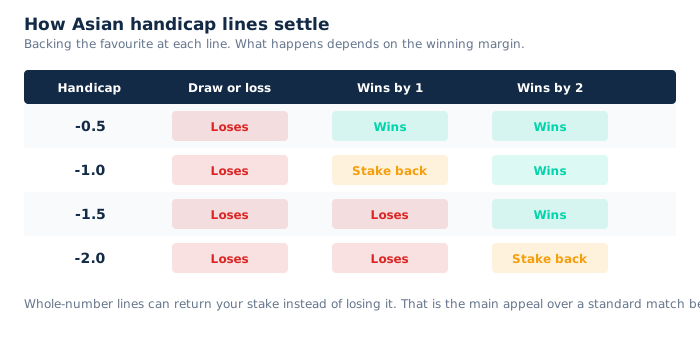
-0.5 (Half Ball)
Your team starts with a -0.5 goal deficit. They must win outright for you to win. No push possible.
Example: Team A -0.5. They win 1-0 → You win (1 - 0.5 = 0.5 goals ahead). Draw or loss → You lose.
+0.5
Your team starts with a +0.5 goal advantage. A draw or win means you win. Only an outright loss loses.
Example: Team B +0.5. They draw 1-1 → You win (1 + 0.5 = 1.5 vs 1). They lose 0-2 → You lose.
-1 (One Goal)
Your team must win by more than one goal. Win by exactly one goal = push (stake refunded).
Example: Team A -1. They win 2-0 → You win. Win 1-0 → Push. Draw or loss → You lose.
-1.5
Your team must win by 2+ goals. No push possible.
Example: Team A -1.5. They win 2-0 → You win. Win 1-0 → You lose.
Quarter Lines (Split Handicaps)
Quarter lines like -0.25, -0.75, -1.25, -1.75 split your stake between two adjacent handicaps.
-0.25 (0, -0.5)
Half your stake goes on 0, half on -0.5.
Example: $100 on Team A -0.25
Win by 1+ goals → Both bets win → Full payout
Draw → $50 on 0 refunded, $50 on -0.5 loses → Half loss
Lose → Both bets lose → Full loss
-0.75 (-0.5, -1)
Half stake on -0.5, half on -1.
Win by 2+ → Both win
Win by 1 → -0.5 wins, -1 pushes → Half win + half refund
Draw or loss → Both lose
Why Professionals Use Asian Handicap
Lower Margins
Two-outcome markets = lower bookmaker margin. Where 1X2 might have 5-8% margin, Asian Handicap often runs 2-4%. Over thousands of bets, this difference is significant.
Eliminates Draw Risk
Football has high draw frequency (25-30% in many leagues). AH removes or reduces this risk through pushes.
Better Value Finding
More handicap options (0, -0.25, -0.5, -0.75, -1, etc.) means more opportunities to find lines where bookmaker pricing is inefficient.
Partial Loss Protection
Quarter lines provide insurance. Instead of losing your entire stake on narrow outcomes, you might only lose half.
Asian Handicap Strategy
Understand Team Margins
Research how teams perform against the handicap historically. Some teams consistently beat handicaps; others regularly fail to cover despite winning matches.
Use for Favorites
When a strong team is heavily favored, -1.5 or -2 AH often offers better value than 1X2 odds of 1.10-1.20.
Line Shopping
Different bookmakers offer slightly different handicap lines. The difference between -0.75 and -1 can be key. Compare across sites.
In-Play Value
Asian Handicap lines move during matches. Early goals can create value opportunities as bookmakers adjust.
Common Mistakes
• Forgetting that quarter lines split your stake
• Not understanding when pushes occur
• Ignoring how a draw affects different handicap levels
• Betting the same handicap regardless of price, line shopping matters
Advanced Asian Handicap Concepts
Alternative Asian Handicaps
Beyond standard lines, bookmakers offer alternative handicaps at different odds. Team A might be -1 at 1.90 odds, but also available at -1.5 at 2.30 or -0.5 at 1.55. Understanding when to take larger handicaps at better odds versus smaller handicaps with higher probability creates value opportunities.
Calculate your estimated win probability at each handicap level and compare to the odds offered. Sometimes the -1.5 line offers better expected value than the "safer" -1 line, despite lower hit rate.
First Half and Second Half Asian Handicaps
Asian Handicap applies to match halves separately. First-half AH markets reflect only first-half scoring, creating distinct betting opportunities. Teams that start slowly but finish strongly show different AH profiles by half.
Second-half markets begin at 0-0 regardless of first-half score, creating situations where teams trailing at halftime offer value on second-half handicaps as they chase the game.
Corner and Card Asian Handicaps
Asian Handicap extends beyond goals to corners, cards, and other statistics. These markets often have higher margins but less sophisticated pricing, potentially offering value for specialists who track these metrics closely.
Asian Handicap vs European Handicap
European Handicap (three-way handicap) maintains the draw as a possible outcome. A team might be -1 in European Handicap, but if they win by exactly one goal, the draw wins, your selection loses.
Asian Handicap's push mechanism makes direct comparison complex, but the absence of draw outcomes generally favors bettors through reduced margin. Professional bettors overwhelmingly prefer Asian Handicap for football.
Reading Asian Handicap Lines
Interpreting Market Expectations
The handicap line itself reveals market expectations. If Team A is -1.5 against Team B, the market expects Team A to win by approximately 2 goals on average. Significant discrepancies between your expectation and the market line indicate potential value, or that the market knows something you don't.
Line Movement Significance
When lines move from -1 to -1.25 or -1.5, it indicates increased confidence in the favorite. Sharp money (professional bettors) often moves Asian Handicap lines before mainstream markets react. Following these movements can reveal where informed money flows.
Calculating Your Own Handicap Probabilities
Advanced bettors develop models estimating goal expectancy for each team. From these expectations, calculate the probability of various winning margins. Compare your margin probabilities to handicap odds to identify value.
For example, if your model suggests Team A beats Team B by 2+ goals 35% of the time, a -1.5 handicap at 3.00 (implied probability 33.3%) represents value. However, ensure your model has proven accuracy before trusting it over market prices.
Bankroll Management for Asian Handicap
Quarter-line bets that split stakes affect bankroll management calculations. A bet on -0.75 isn't truly risking your full stake, half might push or partial win. Factor this into unit sizing decisions.
The lower variance of Asian Handicap (due to pushes and partial outcomes) theoretically allows slightly more aggressive staking than three-way markets, though conservative sizing remains prudent.
Asian Handicap Betting Psychology
The absence of draws changes how bettors think about matches. In traditional 1X2, the draw represents wasted selections: a common third-outcome frustration. Asian Handicap eliminates this anxiety through pushes, making the betting experience less frustrating even when predictions aren't perfect.
However, partial losses on quarter lines can create confusion. Understanding that losing half your stake represents a better outcome than full loss helps maintain proper perspective during losing runs.
Building an Asian Handicap Strategy
Successful Asian Handicap betting requires understanding team goal margins, not just win probabilities. A team that wins 60% of matches but rarely by multiple goals performs differently on -1.5 lines than one winning 55% but frequently crushing opponents.
Track historical performance against Asian Handicap lines specifically. Some teams consistently beat the spread; others regularly fail to cover despite winning matches. This data reveals patterns invisible in simple win/loss records.
Focus on specific leagues where you develop genuine expertise. Asian Handicap pricing quality varies, major leagues are efficiently priced while lower leagues may contain exploitable errors.
Asian Handicap for Different Sports
While Asian Handicap originated in football, the concept applies to other sports. Basketball point spreads function similarly, teams receive point advantages or deficits. Tennis game handicaps follow the same logic for total games won.
Understanding the core principle, eliminating draws through handicaps, helps you apply Asian Handicap thinking across sports even when the specific terminology differs.
Common Asian Handicap Mistakes
Beginners often confuse Asian Handicap with European Handicap. European Handicap maintains the draw as a possible outcome; Asian Handicap eliminates it through pushes and split stakes. This fundamental difference affects both odds and strategy.
Another common error is ignoring team goal-scoring patterns. A team winning 55% of matches might cover -0.5 only 45% of the time if their wins are typically narrow. Historical handicap performance often differs from win percentage.
Failing to line shop specifically for Asian Handicap lines costs value. The difference between -0.75 and -1 lines at different bookmakers can significantly affect expected returns.
Asian Handicap Value Finding
Value in Asian Handicap comes from accurately predicting winning margins, not just outcomes. If you believe a team wins by 2+ goals more often than implied by -1.5 odds, that's value, regardless of their overall win probability.
Analyzing historical margin distributions by team, competition, and situation reveals patterns bookmakers may underweight. Some teams consistently demolish weak opponents; others grind out narrow wins against everyone.
The Future of Asian Handicap Betting
Asian Handicap continues growing in popularity outside Asia. More bookmakers offer detailed AH markets; more bettors understand the advantages over traditional 1X2. This growth increases market efficiency but also liquidity and availability.
For serious football bettors, Asian Handicap literacy is essential. The lower margins, eliminated draw risk, and expanded betting options make it the preferred market for value-focused betting.