Roulette Guide
How roulette works, the math behind every bet, and why betting systems can't overcome the house edge.
How Roulette Works
Roulette is simple: a ball spins around a wheel with numbered pockets, and you bet on where it lands. The complexity comes from understanding the odds and why the casino always has an edge.
The Wheel
There are two main versions:
European Roulette: 37 pockets numbered 0-36. The single zero (green) is the house edge source. House edge: 2.7%
American Roulette: 38 pockets with 0 and 00 (both green). The extra zero nearly doubles the house edge: 5.26%
Always play European roulette when available. There's no strategic reason to ever play American roulette. You're just giving away extra money.
Bet Types and Odds
Inside Bets
These are bets on specific numbers or small groups of numbers:
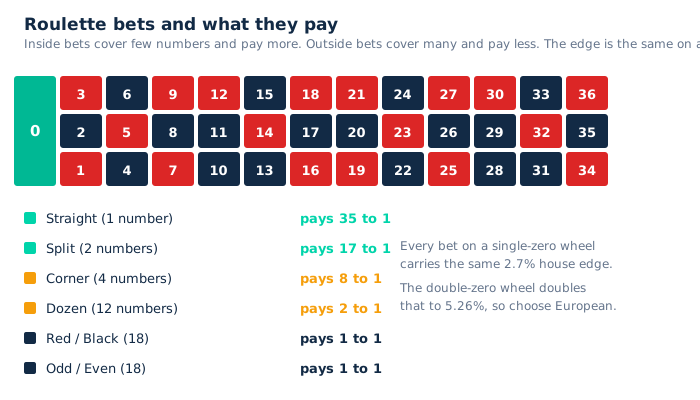
Straight Up (single number): Pays 35:1. True odds: 37:1 (European). This is where you see the house edge clearly, if odds were fair, it would pay 36:1.
Split (two numbers): Pays 17:1. You place the chip on the line between two numbers.
Street (three numbers): Pays 11:1. A row of three numbers like 1-2-3.
Corner (four numbers): Pays 8:1. Chip placed at the intersection of four numbers.
Six Line (six numbers): Pays 5:1. Two adjacent rows.
Outside Bets
These cover larger sections of the wheel:
Red/Black: Pays 1:1. Covers 18 numbers. Win probability: 48.6% (European).
Odd/Even: Pays 1:1. Same as above.
High (19-36)/Low (1-18): Pays 1:1. Same as above.
Dozens (1-12, 13-24, 25-36): Pays 2:1. Win probability: 32.4%.
Columns: Pays 2:1. Same as dozens but arranged differently on the table.
The Math That Matters
Every single bet in roulette has the same house edge (in European roulette: 2.7%). It doesn't matter if you bet on a single number at 35:1 or red/black at 1:1, mathematically, you're expected to lose 2.7% of every bet over time.
The casino achieves this by paying slightly less than true odds. A straight-up bet should pay 36:1 (36 ways to lose, 1 way to win), but it pays 35:1.
Why Betting Systems Don't Work
The Martingale System
The most famous system: double your bet after every loss. When you eventually win, you recover all losses plus one unit profit.
Why it fails:
1. Table limits exist. After 7 consecutive losses starting at $10, you'd need to bet $1,280. Most tables cap at $500-1000.
2. You risk enormous amounts for tiny profits. Betting $1,280 to win $10 is terrible risk/reward.
3. Long losing streaks happen more often than people think. 10 reds in a row occurs roughly once every 1,000 spins.
4. It doesn't change the math. Each spin still has the same house edge regardless of previous results.
The Fibonacci System
Bet following the Fibonacci sequence (1, 1, 2, 3, 5, 8, 13...). Move forward after losses, back two steps after wins.
Why it fails: Same reasons as Martingale, just slower progression. You still hit table limits eventually, and the house edge remains unchanged.
The D'Alembert System
Increase bet by one unit after losses, decrease by one after wins.
Why it fails: Slower than Martingale but identical fundamental flaw, no betting pattern can overcome a negative expectation game.
The Gambler's Fallacy
The belief that past results influence future outcomes. "Red has come up 10 times, black is due!"
Each spin is completely independent. The ball and wheel have no memory. The probability of red or black is exactly the same regardless of what happened before.
What Actually Matters
Game Selection
The only real decision that affects your expected loss is which roulette variant to play:
European (2.7% edge)> French with La Partage (1.35% edge)> American (5.26% edge)
French roulette with "La Partage" returns half your even-money bet when the ball lands on zero, cutting the house edge in half. This is the best roulette game available.
Bankroll Management
Since you can't beat the house edge, the only control you have is managing your money:
• Set a loss limit before you play and stick to it
• Set a win goal, when you hit it, walk away
• Don't chase losses by increasing bets
• Understand that roulette is entertainment with a cost, not a way to make money
Time at Table
The longer you play, the more the house edge grinds you down. Expected loss = total amount wagered × house edge. Betting $10 per spin for 100 spins at European roulette costs you an expected $27.
Online vs. Live Roulette
RNG (Random Number Generator) Roulette: Computer-generated results. Fast gameplay means more spins per hour, which means faster expected losses. Licensed casinos use audited RNGs that produce fair results.
Live Dealer Roulette: Real wheel, real dealer, streamed to your device. Slower pace means less money wagered per hour. The experience is closer to a real casino.
The house edge is identical for both. The main difference is speed and atmosphere.
Roulette Variants
European Roulette
Single zero, 37 pockets, 2.7% house edge. The standard version found in most casinos worldwide.
French Roulette
Same wheel as European but with La Partage or En Prison rules that return half your even-money bet when zero hits. The best version for players at 1.35% house edge on even-money bets.
American Roulette
Double zero (0 and 00), 38 pockets, 5.26% house edge. Worse for players but common in American casinos. Avoid this version when alternatives are available.
Multi-Wheel Roulette
Bet on multiple wheels simultaneously. Faster action but same house edge per wheel. Your expected loss scales with the number of wheels played.
Live Casino Roulette Options
Evolution Gaming dominates live roulette with multiple variants: Lightning Roulette adds random multipliers, Immersive Roulette offers cinematic camera angles, and Speed Roulette accelerates gameplay.
These variants add entertainment value but don't improve your odds. Some, like Lightning Roulette with its multiplier funding, may have slightly worse expected returns than standard versions.
Responsible Roulette Play
Roulette is pure entertainment. The house edge guarantees long-term losses. Accept this before playing and budget accordingly.
Set strict loss limits and stop when reached. Set win goals and walk away when achieved. Never borrow money to gamble. If roulette stops being fun, seek help immediately.
Roulette Myths Debunked
Numbers are never "due" to hit. Each spin is independent: the ball has no memory. Seeing red hit 10 times doesn't make black more likely on spin 11.
Dealers cannot control where the ball lands on a fair wheel. Physical variables make precise prediction impossible even with perfect technique.
Betting systems cannot overcome the house edge. They change variance patterns but not expected outcomes. The casino's mathematical advantage persists through any staking pattern.
Choosing Where to Play
Seek casinos offering French roulette with La Partage rules. This halves the house edge on even-money bets compared to standard European roulette.
If only European is available, that's acceptable. Avoid American roulette when alternatives exist: the extra zero nearly doubles the house edge.
Online live dealer roulette offers slower pace than RNG versions, meaning less money wagered per hour and slower expected losses. The experience is also more engaging.
Final Thoughts
Roulette is purely a game of chance with an immutable house edge. Understanding this enables realistic expectations and healthier gambling behavior. Play for entertainment, set strict limits, and accept that long-term losses are mathematically guaranteed.
Common Questions
Can dealers control where the ball lands? No, physical variables make precise control impossible on fair equipment. Some claim to identify biased wheels, but modern casino maintenance makes exploitable biases extremely rare.
Is online roulette rigged? Licensed casinos use audited random number generators that produce fair results. The house edge is built into the game rules, no rigging is needed for the casino to profit.
What's the best roulette strategy? There is no strategy that overcomes the house edge. Bet sizing systems change variance patterns but not expected outcomes. The best approach is accepting reality and playing for entertainment.
Getting Started
If you're new to roulette, start with even-money bets on European tables. These have the simplest payouts and nearly the best odds available. As you become comfortable, explore inside bets for more variety and excitement.
Remember that no bet type changes the fundamental house edge, only the volatility of your experience differs between betting styles. Play within your limits and enjoy roulette for what it is: pure entertainment.